Bitcoin Cloud Mining
Understand how cloud mining works, compare business models, and learn to evaluate providers before investing.
What is Bitcoin cloud mining?
Rent mining power from a remote data center instead of buying and running your own hardware
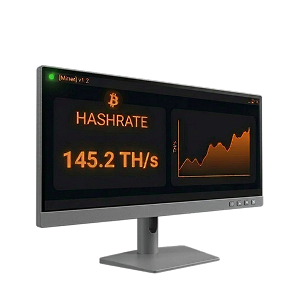 Monitor performance
Track hash rate, uptime, and earnings
Monitor performance
Track hash rate, uptime, and earnings
 Receive bitcoin
Payouts deposited to your account
Receive bitcoin
Payouts deposited to your account
 Own and run hardware
ASIC miners in remote data centers
Own and run hardware
ASIC miners in remote data centers
 Manage operations
Electricity, cooling, maintenance, pool connections
Manage operations
Electricity, cooling, maintenance, pool connections
Mining without hardware
Bitcoin cloud mining lets you purchase hash rate from a company that owns and operates mining equipment in remote data centers. You pay for a contract, typically priced per terahash, and receive a share of the Bitcoin mined, minus fees for electricity and maintenance.
Why it exists
Not everyone can buy a $2,000+ ASIC miner, find cheap electricity, manage heat and noise, and maintain hardware 24/7. Cloud mining abstracts that complexity away, letting anyone participate in mining for a fee.
The core trade-off
If a company can mine Bitcoin profitably with their own hardware, why would they sell that hash rate to you? The answer usually involves capital: providers raise funds by selling contracts, using customer payments to finance equipment and operations. Understanding this dynamic is key to evaluating any cloud mining offer.— The economics of cloud mining
Cloud mining emerged in the early 2010s as Bitcoin mining transitioned from hobbyist CPUs and GPUs to specialized ASIC hardware. As the equipment cost and technical expertise required to mine profitably increased, cloud mining promised to democratize access. Anyone could buy a "contract" representing a share of hash rate in a remote facility.
Today, the industry has evolved into three distinct models. Traditional cloud mining sells hash rate contracts where the provider owns everything. Hosted mining lets you buy actual hardware that runs in a third-party facility. And hashpower marketplaces like NiceHash connect buyers and sellers directly. Each model has different risk profiles and economics.
Before purchasing any cloud mining contract, it is important to understand both the business model and the industry's history. The sections below walk through how these services work, how to compare them, and what to look for when evaluating a provider.
Three ways to mine Bitcoin
Cloud mining, hosted mining, and self-mining each come with different trade-offs in cost, control, and risk
Cloud mining
Buy hash rate contracts. The provider owns and operates all hardware.
- Hardware ownership
- No
- Upfront cost
- Low ($50+)
- Technical skill
- None
- Your control
- None
- Counterparty risk
- Highest
- Fee overhead
- Highest
Hosted mining
Buy your own ASIC and pay a facility to house and run it.
- Hardware ownership
- Yes
- Upfront cost
- Medium ($2,000+)
- Technical skill
- Low
- Your control
- Limited
- Counterparty risk
- Medium
- Fee overhead
- Medium

Self-mining
Buy hardware and run it yourself at home or your own facility.
- Hardware ownership
- Yes
- Upfront cost
- Highest ($2,000+)
- Technical skill
- High
- Your control
- Full
- Counterparty risk
- None
- Fee overhead
- None
How does cloud mining work?
The process from purchasing a contract to receiving Bitcoin payouts
The cloud mining process
What happens when you buy a cloud mining contract.

Choose a provider
Review contract terms, fees, duration, and payout schedules.
Purchase hash rate
Buy a contract (e.g., 10 TH/s for 12 months) with Bitcoin or credit card.
Provider mines for you
Hardware in their data center mines on your behalf via a pool.
Receive payouts
Bitcoin is deposited to your account minus fees. Withdraw to your wallet.
Cloud mining models
The industry uses three distinct approaches: hash rate contracts (traditional cloud mining), hosted mining (you own hardware in their facility), and hashpower marketplaces (peer-to-peer buying and selling of hash rate).
Contract terms to understand
Maintenance fees are deducted from your mining revenue, often daily. If Bitcoin's price drops or network difficulty rises enough, fees can exceed revenue and the contract becomes unprofitable. Some contracts include a clause to terminate automatically if this happens.
Risks and red flags
Cloud mining has the worst fraud track record of any Bitcoin industry segment. Here is what to watch for.
HashFlare: a case study in cloud mining fraud
HashFlare marketed itself as a legitimate cloud mining service from 2015 to 2019, attracting 440,000 customers. In reality, 99% of its claimed mining capacity was fabricated. Dashboards showed fake performance metrics while founders diverted $575 million through shell companies. In February 2025, the co-founders pleaded guilty to wire fraud and money laundering.— U.S. Department of Justice, February 2025
Lost to cloud mining fraud
HashFlare alone defrauded 440,000 investors. The cloud mining industry has a long history of scams, Ponzi schemes, and companies that simply stopped paying out.
Red flags to watch for
Warning signs that a cloud mining service may be fraudulent.
- Guaranteed returns or "risk-free" promises
- No proof of mining facilities or hardware
- Escalating fees required before withdrawal
- Affiliate/referral rewards that seem too generous
- Anonymous team with no verifiable identities
- No registered business entity or jurisdiction
- Dashboard shows mining, but withdrawals never process
Common scam patterns
How cloud mining fraud typically operates.
- Fabricated mining: dashboards show fake hash rate and earnings that do not correspond to real mining activity
- Ponzi structure: early investors are paid with funds from new investors, creating an illusion of profitability until the scheme collapses
- Advance-fee fraud: users are told they have mined Bitcoin, but must pay escalating "taxes" or "fees" to withdraw, which never materialize
- Bait and switch: legitimate mining occurs initially at small scale, then the operator stops mining and pockets new contract payments
The history of Bitcoin cloud mining is largely a history of fraud. Between 2013 and 2020, dozens of cloud mining companies launched, collected customer funds, and eventually disappeared or were exposed as scams. The barriers to entry were low: anyone could build a professional-looking website, display fabricated mining statistics, and sell contracts for hash rate that did not exist.
HashFlare's $575 million fraud was the largest, but far from the only case. Bitcoin Cloud Services ran a $500,000 Ponzi scheme. Scrypt.cc, PB Mining, Zeushash, and Bitminer.io all stopped paying customers. Hashing24 operates what appears to be an advance-fee withdrawal scam, demanding escalating payments before allowing withdrawals that never materialize.
Even companies that were not outright fraudulent often delivered poor results. Cloud mining contracts typically include maintenance fees that eat into returns, and as Bitcoin's network difficulty increases, the same hash rate produces less Bitcoin over time. Many customers found that simply buying Bitcoin directly would have been more profitable than purchasing cloud mining contracts.
How to evaluate a provider
Due diligence checklist for anyone considering cloud or hosted mining
Essential due diligence
Minimum criteria any legitimate provider should meet.
- Registered business entity with verifiable jurisdiction
- Named, identifiable leadership team
- Proof of mining facility (photos, coordinates, third-party verification)
- Transparent fee structure published before purchase
- Clear contract terms including termination conditions
- Withdrawal history: can existing customers actually withdraw?
- Independent reviews on trusted platforms (not just the company's own site)
The key question
Before buying any cloud mining contract, ask: would I be better off simply buying Bitcoin directly with the same amount of money? In most historical cases, the answer has been yes.— Consistent finding across cloud mining profitability analyses
Public company advantage
Publicly traded cloud mining companies (like BitFuFu on NASDAQ) must file audited financial statements with the SEC, disclosing revenue, hash rate, and material risks. This does not eliminate risk, but it provides a level of transparency and legal accountability that private cloud mining operations cannot match.
Verify, don't trust
Claims of partnerships with hardware manufacturers (e.g., Bitmain, BitFury) should be independently verified. Several defunct and fraudulent services claimed major partnerships that turned out to be fabricated or overstated. Check the alleged partner's website for confirmation.
Active providers
Currently operational services. Listing does not constitute endorsement.
Cloud mining carries significant risk. Do your own research before sending funds to any provider.
 marketplace
NiceHash
Visit NiceHash
NiceHash is a hashpower marketplace connecting buyers and sellers of mining capacity. Buyers purchase hash rate on demand with a pay-as-you-go model; sellers connect their mining hardware to NiceHash pools and earn Bitcoin. Operating since 2014, EU-registered, GDPR and AML compliant.
- Founded
- 2014
- Model
- Pay-as-you-go
- Min. investment
- ~$10
 hosted
Compass Mining
Visit Compass Mining
Compass Mining is a US-based hosted mining company that lets customers purchase ASIC miners and host them in third-party facilities. Operates across 20+ sites with 160+ MW of capacity at 7.5-9.5 cents per kWh.
- Founded
- 2020
- Model
- Hardware + hosting
- Min. investment
- ~$2,000+
 cloud
cloud
BitFuFu
Visit BitFuFu
BitFuFu (NASDAQ: FUFU) is a publicly traded cloud mining company offering hash rate contracts backed by Bitmain hardware. Reports 26 EH/s of hash rate as of February 2026. As a NASDAQ-listed, SEC-filing company, it offers more accountability than private cloud mining operations.
- Founded
- 2020
- Model
- Hash rate contracts
- Min. investment
- Varies
Known scams and defunct services
Companies that defrauded customers or are no longer operational
Confirmed scams
These services defrauded customers or stopped paying out entirely.
- HashFlare: HashFlare was a $575 million fraud. The co-founders fabricated 99% of claimed mining capacity, showing fake dashboard performance to approximately 440,000 investors. They pleaded guilty to wire fraud and money laundering in February 2025.
- Hashing24: Hashing24 operates an advance-fee withdrawal scam. Users report paying $200-$500 initially, then being asked for $1,320, then $2,000 in escalating 'fees' before withdrawals are allowed — which never materialize. Claims of BitFury partnerships are unverified. Flagged by Scamadviser.
- Scrypt.cc: Scrypt.cc sold cloud mining hash rate (KHS) and claimed to allow real-time trading. The service stopped paying out and is no longer operational. Do not send funds to this service.
- PB Mining: PB Mining (Piggyback Mining) claimed to operate Bitcoin mining ASICs and offered 'insured' contracts. The service was fraudulent — contracts did not pay out as advertised and the operation shut down.
- Bitcoin Cloud Services (BCS): Bitcoin Cloud Services was a $500,000 Ponzi scheme that defrauded investors.
- Zeushash: Zeushash halted all payouts and ceased operations.
- Bitminer.io: Bitminer.io stopped paying users. Multiple users confirmed they were unable to withdraw funds.
Defunct services
These companies are no longer operational. Do not send funds to any of them.
- Genesis Mining: Genesis Mining stopped offering new cloud mining contracts in 2021. Once the largest cloud mining provider, the company is no longer active in the consumer cloud mining space.
- Minex: Minex presented itself as a blockchain simulation game where users purchased 'Cloudpacks.' The project was abandoned and has no verifiable presence since at least 2024.
- MinerGate: MinerGate was a mining pool that also offered cloud mining. It reportedly closed in 2023 and is no longer operational.
- Hashnest: Hashnest was Bitmain's cloud mining platform, offering Antminer rentals. It was quietly discontinued and has no verifiable operations.
- Bitcoin Cloud Mining: A generic cloud mining service with no verifiable company identity. Contracts were sold out and the service is no longer operational.
- Eobot: Eobot ceased operations around 2025. Multiple sources list it among 'fallen crypto sites.' Users reported being unable to access the platform or withdraw funds.
- MineOnCloud: MineOnCloud offered Bitcoin mining contracts but operated obsolete hardware (AntMiner S4s and S5s). The service is no longer operational.