Bitcoin Mining Pools
Pools combine hash power from thousands of miners to find blocks more frequently and split the rewards proportionally.
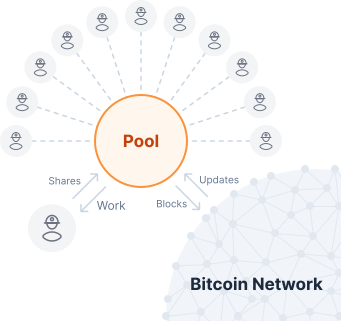
What is a mining pool?
Solo mining with a single ASIC is like buying one lottery ticket — at current difficulty, an Antminer S21 XP would take roughly 65 years on average to find a block. Mining pools let thousands of miners combine their hash power, finding blocks more frequently and splitting rewards proportionally based on each miner's contribution.
Over 95% of all Bitcoin blocks are mined through pools. Most miners earn small, predictable payouts daily instead of waiting for a jackpot that may never come.
How pool mining works
From connecting your miner to receiving your share of the block reward.
Connect your miner
Configure your ASIC with the pool's stratum URL and your wallet address. The miner connects and begins receiving work.

Submit shares
Your miner solves partial proof-of-work puzzles called "shares." Each share proves your hardware is working and contributing.
Pool finds a block
When any miner in the pool finds a valid block, the pool submits it and earns the reward (currently 3.125 BTC plus fees).

Receive your payout
The pool distributes rewards proportionally based on shares submitted. Timing depends on the pool's payout method.
What is a share?
A share is proof that your miner is doing real work. It's a hash that meets a lower difficulty threshold than the actual block target — easier to find but still mathematically valid. The pool tracks shares from all miners to calculate each miner's proportional contribution to the reward.
Pool fees and luck
Pools charge 0-4% of mining rewards. Lower fees aren't always better — consider reliability, payout method, and track record. "Pool luck" means blocks sometimes come faster or slower than average. Some payout methods absorb this variance for you; others pass it through.
Share difficulty and variance
When your miner connects to a pool, the pool assigns it a "share difficulty" — a target much easier than the actual Bitcoin network difficulty. The network difficulty in 2026 exceeds 100 trillion, while a pool might assign share difficulties of just a few billion.
This means your miner can submit shares frequently (every few seconds to minutes), providing granular proof of work. The pool tracks all submitted shares to calculate each miner's proportional contribution.
Pool luck plays a significant role in short-term earnings. A pool is "lucky" when it finds blocks faster than average, and "unlucky" when blocks take longer. Over time, luck averages out to approximately 100%, but in any given week, a pool might be at 80% luck or 120% luck.
This variance is why payout methods matter. FPPS and PPS+ pools absorb luck variance — they pay a fixed rate per share regardless of pool luck. PPLNS pools pass variance through — you earn more during lucky periods and less during unlucky ones.
Bitcoin mining pools compared
All major pools compared by payout method, fees, and features.

Formerly Slush Pool — the world's first Bitcoin mining pool (est. November 2010). Pioneer of Stratum V2 protocol for decentralized block template construction. Offers both FPPS (2% fee) and PPLNS (0% fee) payout options.
- Payout
- FPPS, PPLNS
- Fee
- 2% FPPS / 0% PPLNS


Non-custodial, fully transparent mining pool using the TIDES payout system. Payouts go directly to miners via coinbase transactions — no withdrawal process or counterparty risk. Supports DATUM protocol for miner-side block template construction.
- Payout
- TIDES
- Fee
- 2% (1% with DATUM)

The largest Bitcoin mining pool, controlling roughly 30% of network hash rate. Backed by Digital Currency Group (DCG). Institutional focus with compliance-first operations and deep relationships with North American miners.
- Payout
- FPPS
- Fee
- 0%
AntPool
Operated by Bitmain, the world's largest ASIC manufacturer. Second-largest pool with roughly 18% of network hash rate. Strong presence in China and international markets.
- Payout
- FPPS, PPLNS
- Fee
- 2.5% FPPS / 0% PPLNS

Independent pool operator with roughly 13% of network hash rate. Offers the widest range of payout methods including PPS+, PPLNS, and solo mining. Particularly strong in Russia and surrounding regions.
- Payout
- PPS+, PPLNS, SOLO
- Fee
- 4% PPS+ / 2% PPLNS

One of the oldest pools (est. 2013), also known as Discus Fish. Controls roughly 10% of network hash rate. Known for merge-mining innovation and strong presence in Central Asia.
- Payout
- FPPS
- Fee
- 4% FPPS

Fast-growing pool with roughly 9% of network hash rate. Focuses on institutional miners with competitive FPPS payouts and stable infrastructure. Relatively new but expanding rapidly.
- Payout
- FPPS
- Fee
- FPPS
MARA Pool
Vertically integrated pool operated by Marathon Digital Holdings (NASDAQ: MARA), a publicly traded Bitcoin mining company. Private pool — not open to external miners. Controls roughly 6% of network hash rate.
- Payout
- FPPS
- Fee
- N/A
Luxor
US-based pool with roughly 3% of network hash rate. Offers integrated firmware (LuxOS), hashrate derivatives platform, and fixed/upfront payout options beyond standard FPPS. Also provides miner financing.
- Payout
- FPPS
- Fee
- 0%
Exchange-integrated mining pool operated by Binance, the world's largest crypto exchange. Controls roughly 2% of network hash rate. Miners benefit from seamless integration with Binance's trading and financial ecosystem.
- Payout
- FPPS
- Fee
- 0.5%
Small, community-run pool operating since 2014. Uses the CKPool open-source mining software. Low fees and PPLNS payouts appeal to miners who prioritize decentralization.
- Payout
- PPLNS
- Fee
- 0.9%
Solo mining pool — you get the full block reward (3.125 BTC) if your miner finds a block, or nothing. Maximum variance, maximum reward. Popular with Bitaxe and small ASIC hobby miners chasing a solo block find.
- Payout
- SOLO
- Fee
- 2%
Cipher Mining
Formerly Bitfury. US-based publicly traded Bitcoin mining company (NASDAQ: CIFR) operating a private pool. Not open to external miners.
- Payout
- N/A
- Fee
- N/A
No single pool should control more than 25% of the network's hash rate. When choosing a pool, consider picking a mid-size or smaller pool to support Bitcoin's decentralization. The health of the network depends on hash rate being distributed across many independent operators.
Pool payout methods explained
How pools calculate and distribute mining rewards to participants.
FPPS
Full Pay Per Share
Pays miners for both the block subsidy and an estimated share of transaction fees, per share submitted. Offers the most predictable income — the pool absorbs all variance risk. Higher fees compensate the pool for this risk.
Foundry USA, F2Pool, AntPool, SpiderPool, Luxor, Binance Pool
PPS+
Pay Per Share Plus
Hybrid approach — pays a fixed rate per share for the block subsidy (like PPS), plus distributes transaction fees using a PPLNS method. Slightly less predictable than FPPS but potentially higher payouts when the pool is lucky.
ViaBTC, F2Pool
PPLNS
Pay Per Last N Shares
Rewards are distributed based on shares submitted in a window around when a block is found. Pays more when the pool is lucky, less when unlucky. Lowest fees (often 0%) but highest variance. Miners must stay connected consistently.
Braiins Pool, AntPool, ViaBTC, Kano CKPool
TIDES
Transparent Index of Distinct Extended Shares
Ocean's proprietary transparent payout system. Tracks work in a rolling window equivalent to the last 8 blocks worth of network difficulty. Each payout is fully auditable and paid directly via coinbase transactions — no withdrawal process needed.
Ocean
SOLO
Solo Mining
The pool coordinates work but you receive the entire block reward (currently 3.125 BTC) if your miner finds a block. No reward sharing. Maximum variance — could take years to find a block with a single ASIC, but the full reward is yours.
Solo CKPool, ViaBTC (solo option)
These payout methods were used by early Bitcoin mining pools but are no longer in use by major pools.
PPS (Pay Per Share): Pays a fixed amount for each valid share submitted, based only on the block subsidy (ignoring transaction fees). The pool absorbs all luck variance. Largely replaced by FPPS which also includes transaction fee revenue.
PROP (Proportional): Distributes the block reward proportionally among all miners based on shares submitted during the round. Simple but vulnerable to pool-hopping — miners could jump in right before a block was found.
DGM (Double Geometric Method): Hybrid approach where the pool operator absorbs some risk by receiving a portion of payouts during short rounds and returning it during longer rounds. Designed to normalize payments and reduce variance.
BPM (Bitcoin Pooled Mining): Also known as Slush's method. Older shares from the beginning of a round are weighted less than recent shares. This reduced the incentive for pool-hopping by making late-round shares more valuable.
SCORE (Score-Based): Rewards are weighted by the time work was submitted. Later shares in a round are worth more than earlier ones. Similar intent to BPM — discouraging pool-hopping.
SMPPS (Shared Maximum Pay Per Share): Similar to PPS but the pool never pays out more than it has earned. Protects the pool from going bankrupt during unlucky streaks by capping payouts at available balance.
ESMPPS (Equalized Shared Maximum Pay Per Share): Variant of SMPPS that distributes available funds equally among all miners rather than prioritizing any group.
RSMPPS (Recent Shared Maximum Pay Per Share): Variant of SMPPS that prioritizes the most recent miners first when distributing available funds.
CPPSRB (Capped Pay Per Share with Recent Backpay): Uses a maximum PPS system that pays miners as much as possible from block-finding income without going bankrupt. Unpaid balances carry forward to future rounds.
POT (Pay on Target): High-variance PPS variant that pays based on the difficulty of work returned by the miner rather than the pool's overall difficulty. Rewards miners who submit higher-difficulty shares more generously.
How to choose a mining pool
The right pool depends on your operation size, risk tolerance, and priorities.
Home miner (1-3 ASICs)
Running a miner at home for education, heat, or small-scale earnings.
- Look for steady per-share payouts so income is predictable day to day
- Low minimum payout threshold matters when your hash rate is small
- Simple setup with clear documentation and standard Stratum support
- Consider smaller pools to help keep Bitcoin decentralized
Small farm (3-50 ASICs)
A dedicated mining operation needing reliable, plannable cash flow.
- Predictable revenue is critical for covering electricity and hosting costs
- Fee transparency — understand exactly what you're paying and for what
- Uptime and reliability matter more than small fee differences
- Encrypted connections and security features protect your earnings
Industrial operation (50+ ASICs)
Large-scale mining requiring enterprise-grade infrastructure.
- API access, SLAs, and dedicated support for fleet integration
- Custom fee rates and payout schedules negotiated at scale
- Spread hash rate across multiple pools for risk mitigation
- Jurisdiction and regulatory compliance considerations
Your pool choice affects Bitcoin's decentralization
Mining pools construct the block templates that determine which transactions get included in the blockchain. When you direct your hash power to a pool, you're endorsing their choices about transaction selection and protocol rules.
Two pools — Foundry USA and AntPool — often control roughly 50% of the network's total hash rate. This concentration of block-building power is the biggest trade-off of pool mining.
Stratum V2 addresses this by letting individual miners construct their own block templates instead of relying on the pool operator. Braiins Pool supports Stratum V2 natively, and Ocean uses the DATUM protocol for miner-side template construction.
What miners can do
- Run a full Bitcoin node to verify blocks independently
- Choose pools that support Stratum V2 for miner-side block construction
- Spread hash rate across smaller pools to reduce centralization
- Monitor pool behavior via block explorers like mempool.space
Protocol upgrades and miner signaling
SegWit activated in August 2017 and Taproot in November 2021. Both required miner signaling — pool operators set specific bits in block headers to indicate readiness. When a threshold of blocks (typically 90-95%) signal support, the upgrade activates. This gives pools significant influence over which protocol changes get adopted.
Why running a full node matters
A full node independently validates every block and transaction against Bitcoin's consensus rules. Without one, you're trusting your pool to tell you the truth about the blockchain's state. Running a node ensures that even if your pool includes invalid transactions, your node will reject those blocks.
Full node options include Bitcoin Core (the reference implementation), Bitcoin Knots (enhanced version with additional filtering), and btcd (Go implementation).
Frequently asked questions
Common questions about Bitcoin mining pools.
What is a Bitcoin mining pool?
A mining pool is a group of miners who combine their computational power to find blocks more frequently and split the rewards proportionally. Instead of waiting years for a solo block, pool miners earn small, predictable payouts based on their contribution.
How do mining pool payouts work?
Pools track your "shares" — partial proof-of-work solutions that demonstrate your hash power contribution. When the pool finds a block, rewards are distributed based on shares submitted. The payout method (FPPS, PPLNS, etc.) determines exactly how and when you're paid.
Which payout method is best?
FPPS offers the most predictable income — you get paid a fixed rate per share including estimated transaction fees, regardless of pool luck. PPLNS has lower fees but higher day-to-day variance. For most miners, FPPS provides the best balance of predictability and simplicity.
Can I mine Bitcoin without joining a pool?
Yes, but solo mining is extremely unlikely to be profitable with a single ASIC. At current difficulty, one Antminer S21 XP would take roughly 65 years on average to find a block. Solo mining services like Solo CKPool exist for hobby miners who want to try their luck at a full 3.125 BTC block reward.
How do pool fees work?
Pools charge 0-4% of mining rewards. PPS-based pools (FPPS, PPS+) typically charge 2-4% because they absorb luck variance for you. PPLNS pools often charge 0-2% because miners bear the variance risk. Lower fees don't always mean higher earnings — reliability and uptime matter too.
Does my pool choice affect Bitcoin's decentralization?
Yes. Pool operators decide which transactions go into blocks. When a few large pools control most of the hash rate, it concentrates block-building power. You can help by choosing smaller pools, using pools that support Stratum V2, and running your own Bitcoin full node.